First: Choose the correct answer
The fraction that is equivalent to the fraction $\dfrac{16}{20}$ is ..............
Answer: C $\dfrac{4}{5}$The least Common Multiple (LCM) of the denominators in the following fractions $\dfrac{5}{9}$ and $\dfrac{1}{6}$ is ..............
Answer: C $18$$\dfrac{1}{5}+\dfrac{3}{10}=$ ..............
Answer: A $\dfrac{1}{2}$$\dfrac{1}{6}-\dfrac{1}{3}=$ ..............
Answer: D $\dfrac{4}{24}$$\dfrac{1}{5}+\dfrac{1}{7}=$ ..............
Answer: B $\dfrac{12}{35}$$\dfrac{1}{4}+\dfrac{1}{4}+1=$ ..............
Answer: D $1\dfrac{1}{2}$$\dfrac{1}{5}+\dfrac{2}{5}+3=$ ..............
Answer: D $3\dfrac{3}{5}$$1-\dfrac{2}{6}-\dfrac{3}{6}=$ ..............
Answer: A $\dfrac{1}{6}$$\dfrac{4}{9}+2+\dfrac{1}{9}+4=$ ..............
Answer: B $6\dfrac{5}{9}$The common denominator of these two fractions: $\dfrac{2}{3}$ and $\dfrac{5}{7}$ is ..............
Answer: D $21$The two equivalent fractions of the two fractions $\dfrac{27}{36}$ and $\dfrac{6}{24}$ are ..............
Answer: A $\dfrac{3}{4},\;\dfrac{1}{4}$$5\dfrac{1}{2}+1\dfrac{3}{10}=$ ..............
Answer: D $6\dfrac{4}{5}$$\dfrac{5}{8}-\dfrac{1}{4}=$ ..............
Answer: C $\dfrac{3}{8}$The improper fraction $\dfrac{25}{4}$ is equivalent to ..............
Answer: C $6\dfrac{1}{4}$$\dfrac{1}{7}\times \ldots\ldots\ldots = 2$
Answer: D $14$$3 \div \dfrac{1}{5}=$ ..............
Answer: C $15$Ibrahim bought $20$ pieces of chocolate and gave $\dfrac{3}{5}$ of them to his classmates. The number of pieces he gave to his classmates $=$ ................ pieces.
Answer: C $12$There are $3$ bags of rice. The mass of each bag is $\dfrac{2}{3}$ kg. What is the total mass of the rice? The calculation that can be used to represent the situation is ..............
Answer: C MultiplicationThe shape represents ..............
Answer: B RayA quadrilateral with sides of equal length and angles that are not right angles is a ..............
Answer: C rhombusThe figure .............. represents two perpendicular straight lines
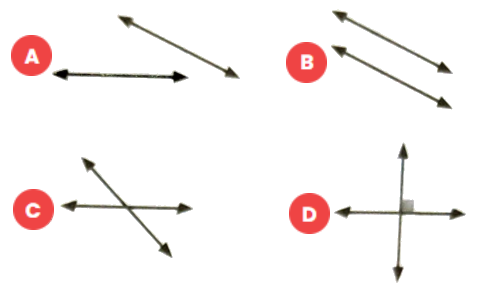
An angle whose measure is greater than $0^\circ$ and less than $90^\circ$ is .............. angle.
Answer: B AcuteA triangle with side lengths of $6$ cm, $4$ cm, and $3$ cm is called .............. triangle according to its side lengths.
Answer: C ScaleneThe area of the opposite rectangle = .............. square units
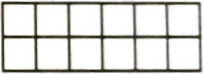
Second: Answer the following:
Write $3$ fractions equivalent to the fraction $\dfrac{3}{7}$.
Answer:$\dfrac{3}{7}=\dfrac{6}{14}$ $=\dfrac{9}{21}$ $=\dfrac{12}{28}$
Find the result of the following: $\dfrac{1}{3}+\dfrac{1}{4}$.
Answer:LCM for $3$ and $4=12$
$\dfrac{1}{3}=\dfrac{4}{12}$ and $\dfrac{1}{4}=\dfrac{3}{12}$
So, $\dfrac{4}{12}+\dfrac{3}{12}$ $=\dfrac{7}{12}$
Suad has $\dfrac{3}{4}$ liter of juice. She drank $\dfrac{1}{3}$ liter from it. How many liters are left?
Answer:Remaining juice $=\dfrac{3}{4}-\dfrac{1}{3}$
LCM for $4$ and $3=12$
$\dfrac{3}{4}=\dfrac{9}{12}$ and $\dfrac{1}{3}=\dfrac{4}{12}$
So, the emaining juice $= \dfrac{9}{12}-\dfrac{4}{12}$ $=\dfrac{5}{12}$ liter.
Find the result of the following: $\dfrac{7}{12}-\dfrac{1}{7}$.
Answer:LCM for $12$ and $7=84$
$\dfrac{7}{12}=\dfrac{49}{84}$ and $\dfrac{1}{7}=\dfrac{12}{84}$
So, $\dfrac{49}{84}-\dfrac{12}{84}$ $=\dfrac{37}{84}$
Find the result of the following: $2+\dfrac{1}{5}+\dfrac{1}{2}$.
Answer:LCM for $5$ and $2=10$
$\dfrac{1}{5}=\dfrac{2}{10}$ and $\dfrac{1}{2}=\dfrac{5}{10}$
So, $\dfrac{2}{10}+\dfrac{5}{10}$ $=\dfrac{7}{10}$
Therefore, $2+\dfrac{7}{10}=2\dfrac{7}{10}$
Find the result of the following: $1-\dfrac{1}{7}-\dfrac{1}{2}$.
Answer:LCM for $7$ and $2=14$
$1 = \dfrac{14}{14}\,, \dfrac{1}{7}=\dfrac{2}{14}$ and $\dfrac{1}{2}=\dfrac{7}{14}$
So, $\dfrac{14}{14}-\dfrac{2}{14}-\dfrac{7}{14}$ $=\dfrac{5}{14}$
Write the two fractions with a common denominator using equivalent fractions $\dfrac{5}{15}$ and $\dfrac{14}{21}$.
Answer:LCM for $15$ and $21=105$
$\dfrac{5}{15}=\dfrac{35}{105}$ and $\dfrac{14}{21}=\dfrac{70}{105}$
Find the result of the following: $1\dfrac{1}{8}+2\dfrac{1}{4}$.
Answer:LCM for $8$ and $4=8$
$\dfrac{1}{4}=\dfrac{2}{8}$
So, $1\dfrac{1}{8}+2\dfrac{2}{8}$ $=(1+2)+\left(\dfrac{1}{8}+\dfrac{2}{8}\right)$ $=3\dfrac{3}{8}$
Subtract: $3\dfrac{5}{6}-1\dfrac{1}{3}$.
Answer:LCM for $6$ and $3=6$
$\dfrac{1}{3}=\dfrac{2}{6}$
So, $3\dfrac{5}{6}-1\dfrac{2}{6}$ $=(3-1)+\left(\dfrac{5}{6}-\dfrac{2}{6}\right)$ $=2\dfrac{3}{6}$ $=2\dfrac{1}{2}$
find the product of each of the following in its simplest
form:
(a) $1\dfrac{1}{2}\times\dfrac{2}{3}$
(b) $2\dfrac{2}{5}\times\dfrac{2}{3}$
(c) $\dfrac{3}{8}\times2\dfrac{1}{2}$
(a) $1\dfrac{1}{2}\times\dfrac{2}{3}$ $=\dfrac{3}{2}\times\dfrac{2}{3}$ $=\dfrac{6}{6}=1$
(b) $2\dfrac{2}{5}\times\dfrac{2}{3}$ $=\dfrac{12}{5}\times\dfrac{2}{3}$ $=\dfrac{24}{15}$ $=\dfrac{8}{5}=1\dfrac{3}{5}$
(c) $\dfrac{3}{8}\times2\dfrac{1}{2}$ $=\dfrac{3}{8}\times\dfrac{5}{2}$ $=\dfrac{15}{16}$
Find the product in its simplest form:
(a) $1\dfrac{2}{3}\times4\dfrac{2}{5}$
(b) $2\dfrac{1}{3}\times1\dfrac{5}{7}$
(c) $3\dfrac{1}{3}\times5\dfrac{1}{2}$
(a) $1\dfrac{2}{3}\times4\dfrac{2}{5}$ $=\dfrac{5}{3}\times\dfrac{22}{5}$ $=\dfrac{110}{15}$ $=\dfrac{22}{3}=7\dfrac{1}{3}$
(b) $2\dfrac{1}{3}\times1\dfrac{5}{7}$ $=\dfrac{7}{3}\times\dfrac{12}{7}$ $=\dfrac{84}{21}$ $=4$
(c) $3\dfrac{1}{3}\times5\dfrac{1}{2}$ $=\dfrac{10}{3}\times\dfrac{11}{2}$ $=\dfrac{110}{6}$ $=\dfrac{55}{3}=18\dfrac{1}{3}$
Farah has $2\dfrac{1}{3}$ bags of rice. Each bag contains $1\dfrac{5}{7}$ kg of rice. How much rice does Farah have?
Answer:Total rice $=2\dfrac{1}{3}\times1\dfrac{5}{7}$ $=\dfrac{7}{3}\times\dfrac{12}{7}$ $=\dfrac{84}{21}$ $=4$
Therefore, Farah has $4$ kg of rice.
Amal bought $2\dfrac{1}{3}$ kg of oranges. The price per kilogram is $10\dfrac{1}{2}$ pounds. What is the total amount that Amal pays?
Answer:Total cost $=2\dfrac{1}{3}\times10\dfrac{1}{2}$ $=\dfrac{7}{3}\times\dfrac{21}{2}$ $=\dfrac{147}{6}$ $=\dfrac{49}{2}$ $=24\dfrac{1}{2}$
Therefore, Amal pays $24\dfrac{1}{2}$ pounds.
Find in its simplest form:
(a) $2\div3=$ ............
(b) $3\div2=$ ............
(c) $3\div5=$ ............
(a) $2\div3=\dfrac{2}{3}$
(b) $3\div2=\dfrac{3}{2}=1\dfrac{1}{2}$
(c) $3\div5=\dfrac{3}{5}$
Find the quotient as an improper fraction and put it in its simplest form:
(a) $12\div5$
(b) $11\div3$
(c) $14\div5$
(a) $12\div5=\dfrac{12}{5}=2\dfrac{2}{5}$
(b) $11\div3=\dfrac{11}{3}=3\dfrac{2}{3}$
(c) $14\div5=\dfrac{14}{5}=2\dfrac{4}{5}$
Write the unknown number in each equation:
(a) $\dfrac{1}{9}\div a=\dfrac{1}{45}$
(b) $b\times\dfrac{1}{9}=\dfrac{1}{45}$
(a) $a=\dfrac{1}{9}\div\dfrac{1}{45}$ $=\dfrac{1}{9}\times\dfrac{45}{1}$ $=\dfrac{45}{9}$ $=5$
(b) $b=\dfrac{1}{45}\div\dfrac{1}{9}$ $=\dfrac{1}{45}\times\dfrac{9}{1}$ $=\dfrac{9}{45}$ $=\dfrac{1}{5}$
Find the quotient in its simplest form:
(a) $\dfrac{1}{7}\div2=$ ..............
(b) $\dfrac{1}{4}\div3=$ ..............
(a) $\dfrac{1}{7}\div2$ $=\dfrac{1}{7}\times\dfrac{1}{2}$ $=\dfrac{1}{14}$
(b) $\dfrac{1}{4}\div3$ $=\dfrac{1}{4}\times\dfrac{1}{3}$ $=\dfrac{1}{12}$
Find the quotient in its simplest form:
(a) $2\div\dfrac{1}{3}=$ ..............
(b) $4\div\dfrac{1}{3}=$ ..............
(a) $2\div\dfrac{1}{3}$ $=2\times3$ $=6$
(b) $4\div\dfrac{1}{3}$ $=4\times3$ $=12$
Write the unknown number in each equation:
(a) $8\div a=24$
(b) $b\times8=24$
(a) $a=8\div24$ $=\dfrac{8}{24}$ $=\dfrac{1}{3}$
(b) $b= 24\div8 =$ $3$
A quadrilateral has only one pair of parallel sides. What is it?
Answer: A trapezoid.A polygon has four sides of equal length and 4 right angles. What is it?
Answer: A square.Write the number of lines of symmetry for each of the following: square, rhombus, rectangle and parallelogram.
Answer:Square: 4
Rhombus: 2
Rectangle: 2
Parallelogram: 0
How to study for the March Math Test (Grade 5):
1. Practice finding equivalent fractions and writing fractions with a common denominator.
2. Review how to add and subtract fractions with different denominators.
3. Practice multiplying fractions and mixed numbers and simplify the result.
4. Learn how to divide fractions and whole numbers.
5. Practice converting mixed numbers to improper fractions before multiplication.
6. Solve simple equations to find unknown numbers.
7. Practice solving word problems involving fractions and mixed numbers.
8. Review basic geometry concepts such as quadrilaterals and lines of symmetry.